
What is Secondary Containment?
Requirements, Types, and the 110% Rule
Secondary containment is a system designed to capture a spill or leak from a primary storage container before it reaches soil, groundwater, drains, or surface water. Common types include containment berms, dikes, curbs, pits, spill pallets, double-wall tanks, and lined containment areas. For facilities subject to EPA SPCC requirements, bulk storage containment must hold the full capacity of the largest single container plus sufficient freeboard for precipitation.
When a tank, drum, or other storage container fails, the primary container is no longer enough to protect the surrounding environment. Secondary containment provides another layer of protection by capturing spilled material and keeping it from spreading.
For facility managers and EHS professionals, understanding secondary containment means understanding more than the basic definition. The containment system must be appropriately sized, sufficiently impervious for the material being stored, and designed for the facility’s specific risks and regulatory requirements.
The commonly discussed “110% rule” is part of that conversation, but there’s an important distinction: the EPA does not simply state that every secondary containment system must hold 110% of a container. For facilities subject to the Spill Prevention, Control, and Countermeasure (SPCC) rule, the federal requirement for bulk storage containers is the capacity of the largest single container plus sufficient freeboard for precipitation. The 110% figure is widely used as a practical sizing benchmark.
What Is Secondary Containment?
Secondary containment is a backup system designed to contain a release if a primary storage container, tank, pipe, or piece of equipment leaks or fails.
The primary container is the tank, drum, tote, or vessel holding the material. Secondary containment surrounds or supports the primary container, and it collects any spills within a controlled area.
Depending on the application, secondary containment may comprise:
- Concrete or steel containment areas
- Berms and dikes
- Containment curbs
- Spill pallets
- Containment pits
- Double-wall tanks
- Lined earthen containment
- Drainage and collection systems
- Remote containment basins
The goal is straightforward: if the primary container fails; the material released must remain contained long enough for recovery or safe cleanup.
Contact Us Today!


Primary vs. Secondary Containment
Understanding the difference between primary and secondary containment makes the concept much easier to visualize.
Primary Containment
Primary containment is the structure that holds the material.
Examples include:
- Storage tanks
- Drums
- IBC totes
- Process vessels
- Piping
- Transport containers
The primary container is the first line of defense against a release.
Secondary Containment
Secondary containment provides protection if the primary system leaks or fails.
For example, a tank may sit inside a concrete containment area surrounded by a berm. The tank is the primary containment system, while the bermed area is the secondary containment.
You can add a liner to the containment area to make the surface sufficiently impervious for the material being stored and help prevent a release from migrating into the surrounding soil.
Quality-First Manufacturing
We manufacture each one of our liners with the strongest materials, resulting in a longer lifespan. The liner itself is strong enough to protect the container, while being resistant to chemical corrosion. Providing a complete solution for a variety of industries.
Why Is Secondary Containment Important?
A tank failure does not have to mean an environmental disaster.
A properly designed containment system can limit the spread of a release, simplify cleanup, and reduce the likelihood that spilled material reaches:
- Soil
- Groundwater
- Storm drains
- Surface water
- Neighboring property
- Other areas of the facility
Secondary containment can also make spill response more manageable because it collects the released material in a defined area rather than allowing it to spread across an uncontrolled surface.
For facilities handling oil, the EPA’s SPCC regulations establish requirements intended to prevent oil discharges to navigable waters and adjoining shorelines.
What Are the Secondary Containment Requirements?
Secondary containment requirements depend on what is being stored, where it is stored, and which regulations apply to the facility.
For example, the federal SPCC rule under 40 CFR Part 112 contains specific requirements for regulated oil storage facilities.
Under 40 CFR 112.8(c)(2), bulk storage container installations must provide secondary containment for the entire capacity of the largest single container plus sufficient freeboard to contain precipitation. The containment must also be sufficiently impervious to contain discharged oil.
Other federal, state, or local requirements may apply depending on the material and facility.
This means facility managers should not assume that one containment design satisfies every regulatory program. Evaluate the applicable requirements before designing or modifying a containment system.
What Is the 110% Rule for Secondary Containment?
The “110% rule” is commonly used as a practical way to size secondary containment.
Under this approach, a containment area is designed to hold at least 110% of the capacity of the largest container within the area.
For example, if the largest tank holds 10,000 gallons, a 110% calculation would produce a target capacity of:
10,000 gallons × 1.10 = 11,000 gallons
However, there’s an important regulatory distinction.
The EPA’s SPCC requirements do not establish a universal 110% minimum. Instead, the rule requires containment for the entire capacity of the largest single bulk storage container plus sufficient freeboard for precipitation. EPA guidance identifies the 25-year, 24-hour storm as an appropriate benchmark for determining sufficient precipitation freeboard, although the EPA did not make that storm event a specific regulatory standard.
As a result, the actual containment capacity calculation should account for the facility, container arrangement, applicable regulations, and precipitation exposure.
Why is Freeboard Important?
A containment area located outdoors has another potential source of liquid to account for: rain.
If a containment berm is sized only to hold the contents of the largest tank, heavy rainfall could fill part of that capacity before a spill occurs.
Freeboard provides additional capacity for precipitation.
EPA guidance explains that sufficient freeboard should account for precipitation, with the 25-year, 24-hour storm used by the EPA as an appropriate benchmark for most facilities.
What Qualifies as Secondary Containment?
There is no single type of structure that every facility must use.
The system depends on the facility layout, storage containers, materials being stored, available space, drainage, and applicable requirements.
Common secondary containment systems include the following.
Berms and Dikes
Berms and dikes create a raised perimeter around tanks or other storage areas.
They are commonly used for outdoor tank farms and can be constructed from concrete, steel, compacted soil, or other suitable materials.
For oil storage under SPCC, diked areas must be sufficiently impervious to contain discharged oil.
Containment Curbs
Containment curbs create a lower-profile barrier around a storage or process area.
They can be useful where a full-height berm is unnecessary or where facility traffic and access need to be maintained.
Containment Pits
Containment pits provide a recessed area where released material can collect.
They may be constructed as part of a facility’s original infrastructure or incorporated into an industrial containment system.
Spill Pallets and Portable Containment
Smaller containers such as drums and totes may be placed on spill pallets or other portable containment systems.
These solutions can be practical for facilities that need containment around individual containers rather than a large tank farm.
Double-Wall Tanks
A double-wall tank incorporates a secondary containment space directly into the tank design.
If the inner tank fails, the outer wall provides an additional barrier against release.
Lined Earthen Containment
Large agricultural, industrial, or environmental containment areas may use compacted earth combined with a liner system.
A flexible liner can create a low-permeability barrier across a berm, pit, pond, or other containment area.
This is useful when the surrounding soil cannot reliably prevent the contained material from migrating into the ground.
Why Does the Containment Surface Matter?
Building a berm is only part of the containment solution.
If the containment area has a permeable floor or walls, a spill may migrate through the surface before it can be recovered.
For this reason, the containment surface needs to be appropriate for the material being stored and the applicable regulatory requirements.
Depending on the project, the containment area may use:
- Concrete
- Steel
- Compacted clay
- Geomembranes
- Flexible PVC liners
- Other compatible lining materials
The correct material depends on chemical compatibility, environmental exposure, physical conditions, and regulatory requirements.
How Do Secondary Containment Liners Work?
A secondary containment liner creates a barrier between the contained material and the underlying structure or soil.
For example, a facility may have a concrete containment berm around an industrial tank. A flexible liner installed across the floor and up the containment walls can help prevent spilled material from penetrating cracks, joints, or porous areas in the concrete.
This makes the liner part of the containment system rather than simply a protective coating.
For large containment areas, custom-fabricated liner systems can be manufactured to fit the dimensions of the berm, pit, or containment structure.
Who Needs Secondary Containment?
The answer depends on the material being stored and the regulations applicable to the facility.
Facilities that store regulated quantities of oil may be subject to EPA SPCC requirements. Under the SPCC rule, bulk storage container installations generally require a secondary means of containment sized for the largest single container plus precipitation freeboard.
Other facilities may have secondary containment obligations under different federal, state, or local environmental, fire, or hazardous-material regulations.
Examples of facilities that commonly use secondary containment include:
- Petroleum storage facilities
- Manufacturing plants
- Chemical processing facilities
- Water and wastewater operations
- Agricultural operations
- Fuel storage areas
- Industrial maintenance facilities
- Warehouses storing liquid materials
The exact requirement should always be determined based on the materials, quantities, facility design, and regulations applicable to the specific site.

How Should a Secondary Containment System Be Designed?
Effective secondary containment requires more than just calculating a volume.
Storage Capacity
Determine the volume of the largest container and the total volume that must be contained under the applicable regulations.
Precipitation
For outdoor systems, account for the required precipitation freeboard.
Drainage
Consider how rainwater and spilled materials will be managed. EPA’s SPCC requirements address drainage from diked storage areas and require controls designed to prevent an oil discharge from escaping through the drainage system.
Material Compatibility
The containment surface and liner need to be compatible with the material being stored.
A system designed for water may not be appropriate for petroleum products, solvents, fertilizers, or other chemicals.
Structural Condition
Existing concrete, berms, pits, and other structures should be evaluated for cracks, deterioration, settlement, and other conditions that could compromise containment.
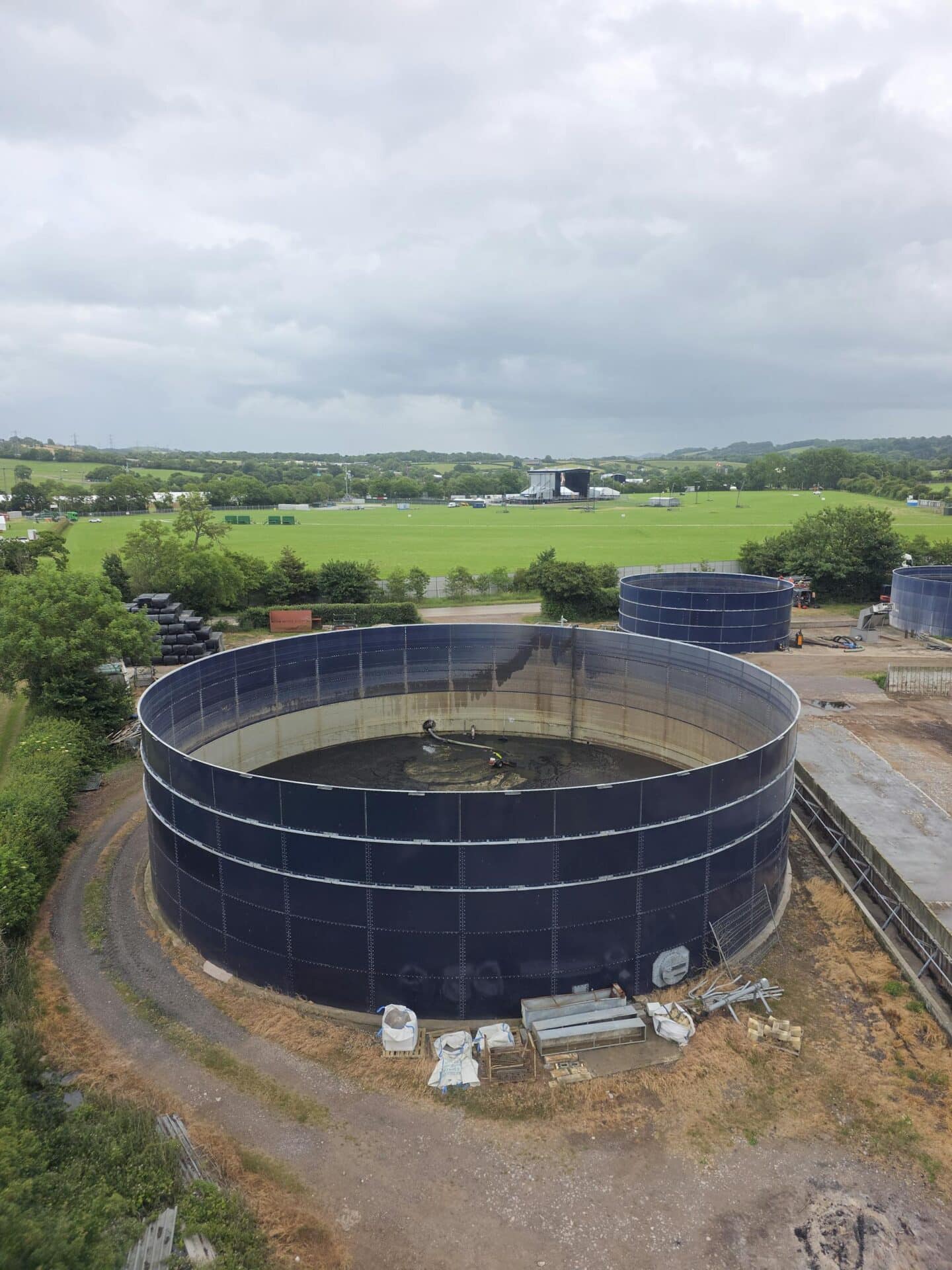
Learn more about the different secondary containment liner options.
Maintaining and Inspecting Secondary Containment
Secondary containment should be inspected regularly for conditions that could reduce its effectiveness.
Depending on the system, inspections may look for:
- Cracked concrete
- Damaged liners
- Failed seams
- Erosion
- Settlement
- Vegetation growth
- Accumulated water or debris
- Blocked drainage
- Deteriorated berms
- Signs of chemical exposure
EPA also recommends that facilities maintain information supporting the adequacy of their containment calculations, even though SPCC regulations do not require facilities to keep the calculations themselves in the SPCC Plan.
When Should a Secondary Containment Liner Be Considered?
A liner may be worth considering when an existing containment structure is usable but its surface cannot reliably contain the stored material.
For example, a facility may have a concrete berm that is structurally sound but has developed cracks, porous areas, or deteriorated joints.
Rather than rebuilding the entire containment structure, a compatible liner can provide a new containment barrier across the existing surface.
This can be especially valuable when the alternative would involve extensive demolition, reconstruction, or facility downtime.
Frequently Asked Questions
What is the 110% rule for secondary containment?
The 110% rule is a commonly used sizing benchmark that provides containment capacity equal to 110% of the largest container. However, the EPA’s SPCC rule does not establish a universal 110% requirement. For regulated bulk oil storage, the federal requirement is the full capacity of the largest single container plus sufficient freeboard for precipitation.
What qualifies as secondary containment?
Berms, dikes, containment curbs, pits, spill pallets, double-wall tanks, and lined containment areas can all serve as secondary containment when properly designed and sized for the applicable requirements.
Who needs secondary containment?
Facilities may need secondary containment when required by federal, state, or local regulations governing the materials they store. Facilities subject to the EPA’s SPCC rule have specific secondary containment requirements for regulated bulk oil storage containers.
Does secondary containment have to be lined?
Not necessarily. The construction depends on the material, site conditions, regulatory requirements, and containment design. However, a liner can be an effective way to make an existing berm, pit, or containment area more resistant to leaks and migration.
How much freeboard does secondary containment need?
For SPCC-regulated bulk storage, containment must provide sufficient freeboard to contain precipitation. EPA identifies the 25-year, 24-hour storm as an appropriate benchmark for most facilities, although the regulation itself does not establish that storm event as a universal minimum.
Can an existing containment area be lined?
Yes. Existing berms, pits, concrete containment areas, and other structures can be lined to improve their ability to contain spills. The existing structure should first be evaluated for structural condition, dimensions, drainage, and compatibility with the proposed liner.

Protect the Containment System You Already Have
Secondary containment does not always require rebuilding an entire facility.
Many times, you can upgrade an existing berm, pit, or containment structure with a properly selected liner. This approach can provide a new containment barrier while allowing the facility to continue using its existing infrastructure.
Fab-Seal specializes in custom-fabricated PVC liner systems for industrial containment applications. We can design liners for berms, pits, tanks, ponds, and other containment structures where reliable liquid containment is essential.
If your facility has aging or deteriorated containment and you’re evaluating whether repair, lining, or complete reconstruction makes the most sense, Fab-Seal can help assess the application and identify a practical containment solution.
Call (800) 874-0166, or fill out our form to discuss your secondary containment requirements and learn whether a custom liner can improve the performance of your existing containment system.
Get Started!
Contact us today and learn how our custom-fabricated liners are the ideal solution for most containment applications!